
Birgunj,
Schools are playing double standards
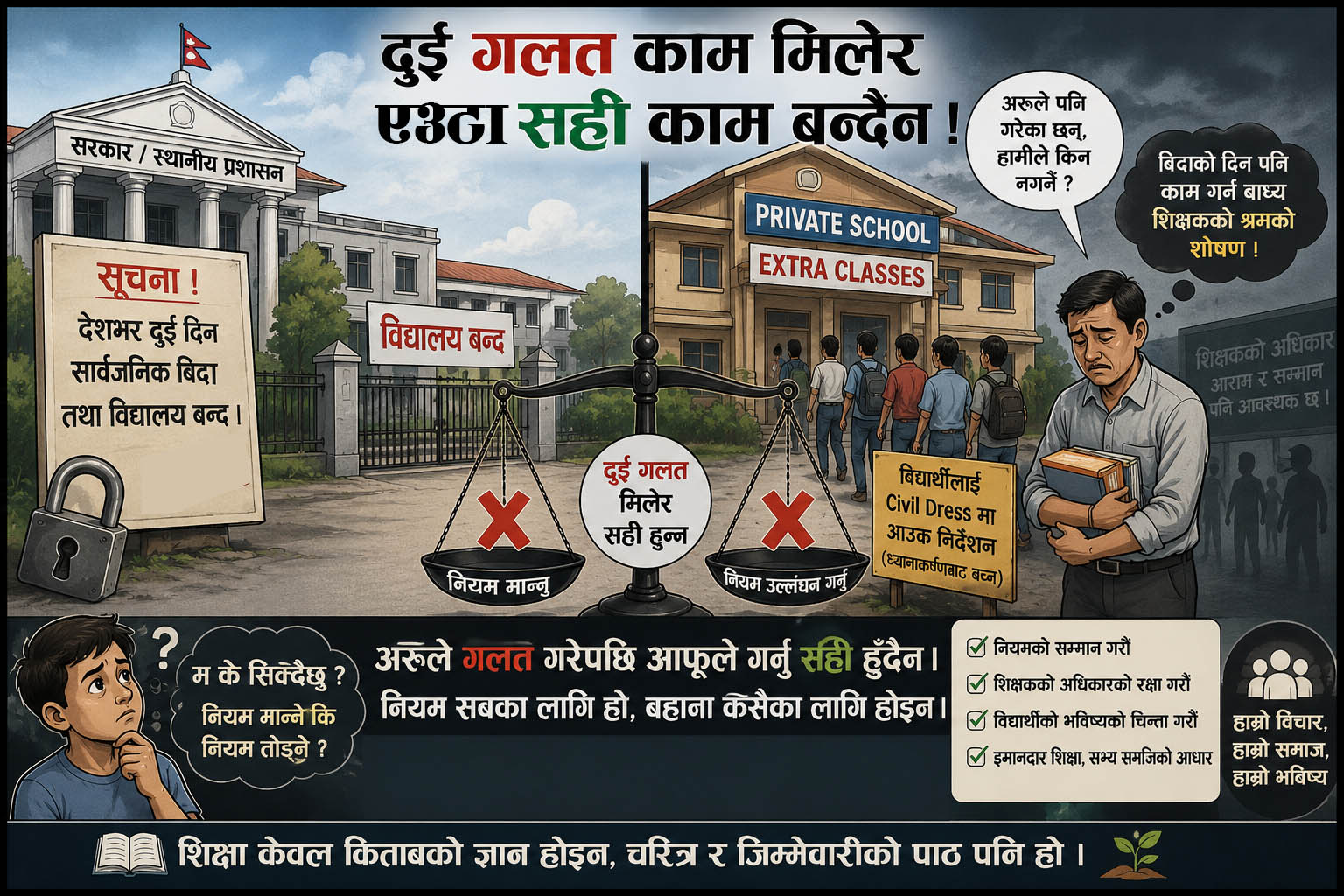
“Two wrongs don’t make a right.” Yet, in Birgunj, this simple moral lesson seems to have become an optional chapter for some private schools. When the competent authorities announce the closure of schools and a two-day holiday across Nepal, some institutions apparently discover a creative loophole: “extra classes.” And when even that feels too visible, students are reportedly asked to come in civil dress, as if changing the uniform can also change the legality or morality of opening a school. What an ingenious solution! Perhaps the next step will be to turn the school signboard upside down and declare that the building is no longer a school for those two days.

The most amusing justification is even simpler: “Others are doing it, so why can’t we?” This is precisely where we should ask what we are teaching our children. If another school violates a rule, does that automatically give every other school a licence to violate it too? If one person jumps a red light, should everyone behind him follow, and then collectively argue that the traffic signal was unfair? Pointing at someone else’s wrongdoing does not transform our own wrongdoing into a right. A school is not merely a business that counts classroom hours; it is an institution entrusted with shaping young minds. If teachers are compelled to work even on officially declared holidays, sometimes under the convenient label of “extra classes,” then the issue is no longer simply about education. It raises serious questions about teachers’ dignity, labour rights, institutional accountability and respect for official decisions.
And perhaps the authorities, parents and local community should ask one uncomfortable question: What exactly are we teaching our students by doing this? That rules are important only when others follow them? That authority can be respected selectively? That exploitation becomes acceptable when someone else is also doing it? Teachers deserve holidays, rest and dignity just as students do. Parents deserve institutions that follow the rules rather than cleverly work around them. And students deserve an education that teaches them integrity not hypocrisy. If “everyone else is doing it” becomes our standard of right and wrong, then we are not educating a generation; we are merely training them to find better excuses.